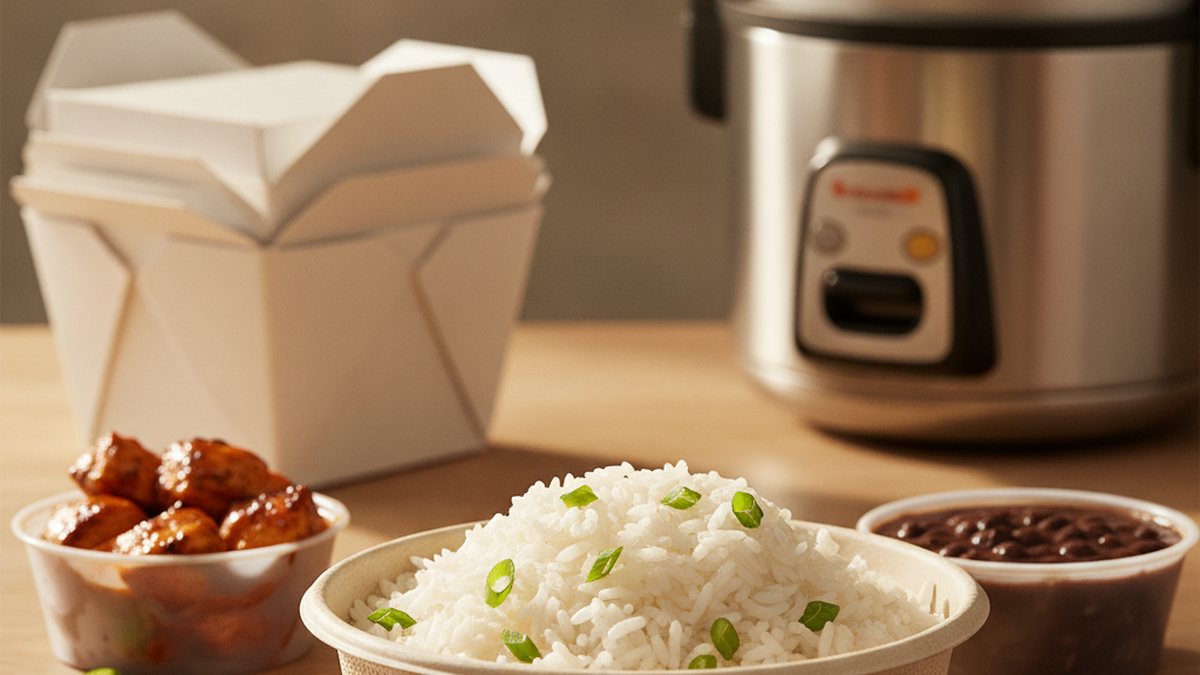
Of all the things a global chain can add to a menu, rice is among the most consequential and the least appreciated. It is not a new item. It is a new operation.
What adding rice actually requires
- Equipment. Rice cookers and holding equipment, occupying floor space that a quick-service kitchen does not have spare.
- A holding process. Rice has a quality window. Managing it across a shift is a discipline in itself.
- Packaging. A container that holds a plated meal is not a wrapper. Different supply, different cost, different stacking.
- Portioning. Rice is portioned by scoop and weight rather than by count, which changes training and consistency.
- Cutlery. A plated rice meal is not eaten with your hands, which changes the packaging list again.
None of that is exotic; all of it is cost. A chain that has done it in a market has concluded that the market genuinely requires it.
Rice on the board means somebody signed off on a rice cooker, and that is a much bigger decision than a new sauce.
Where rice appears
Our rice and bowls category holds 239 items, and the geographic concentration is close to absolute: it is an Asia-Pacific phenomenon in our data, with the Philippines, Thailand, Malaysia, Singapore and Hong Kong carrying the overwhelming majority.
Open McDonald's in the Philippines and rice is not a side note. It is structural - A base that other items are sold alongside, exactly as fries are elsewhere.
What rice does to the pricing
Rice is cheap, filling and familiar, which changes what a menu can offer at the bottom of its range. A rice-based meal can hit a low price point while still being a proper meal, in a way that a burger of the same price cannot.
| Base | Cost to the operator | Perceived as a full meal? | Effect on entry price |
|---|---|---|---|
| Rice | Very low | Yes | Enables a genuinely low entry point |
| Bread or bun | Low | Depends on size | Moderate |
| Fries as the only side | Low | Rarely on its own | Pushes the meal price up |
| Noodles | Low | Yes | Similar to rice |
That is part of why the most rice-heavy markets in our data are also among the cheapest in the price index. A menu with a cheap, filling, culturally central base can reach a price point a bread-based menu struggles to.
It changes how the meal is eaten
A handheld meal is designed for a bag, a car and one hand. A plated rice meal assumes a table, cutlery and time. That is a different visit, and it interacts with everything else about the restaurant - Dwell time, seating ratio, staffing, even how the dining room is laid out.
Which is why rice-heavy markets in our data also tend to be the markets where table service and seated dining are more common, and where drive-thrus are less central. See the drive-thru is a geography problem and table service at a fast-food counter.
The one-item test for localisation
If you want to know how seriously a chain has localised a market, do not look at the novelty burger. Look for rice. Everything else can be a sauce swap; rice is a capital expenditure.
And the reverse case
Rice almost never travels the other way. Rice dishes developed for Asian markets do not appear on Western boards, for the same operational reasons in reverse: no equipment, no process, no packaging, and no established expectation that a chain restaurant serves them.
That asymmetry is a good illustration of how localisation actually works. It is not cultural exchange; it is each market's operation adapting to its own customers. For the broader pattern, see how a global chain learns a country.