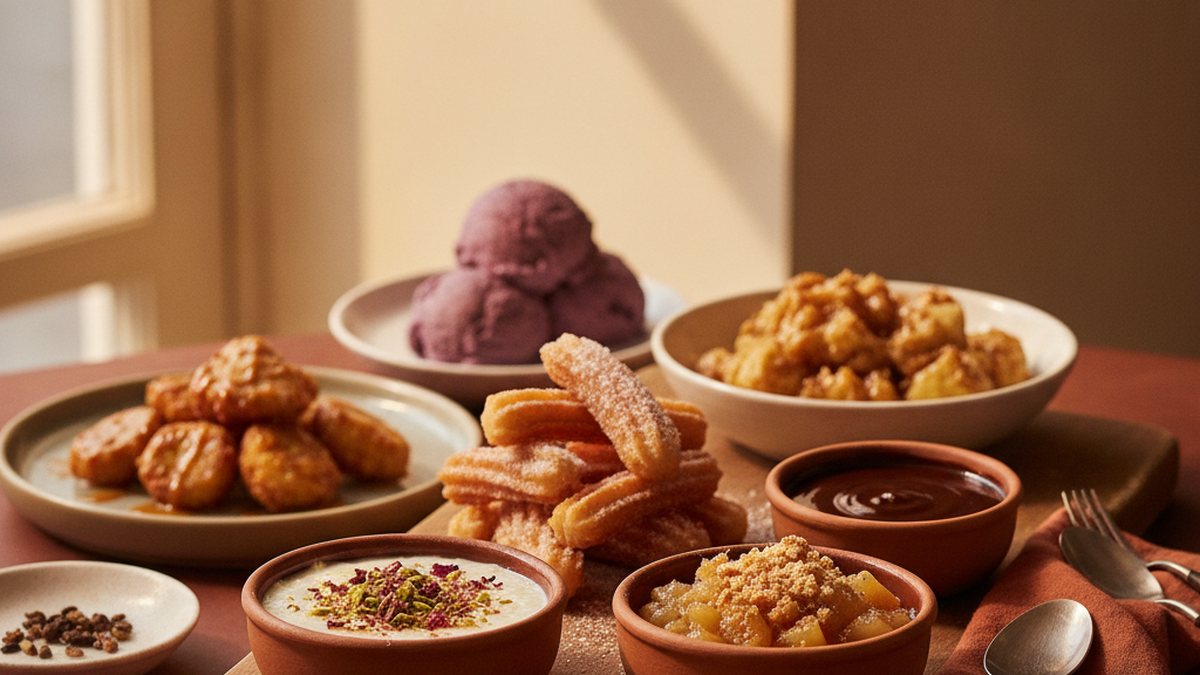
If you want to see what a country actually likes, skip the burgers and read the dessert section. It is the part of a chain menu that varies most between markets, for reasons that are half cultural and half operational.
Why desserts localise so readily
Two reasons, and both matter.
Sweet preferences genuinely diverge more than savoury ones. What counts as an appropriate level of sweetness, an appropriate texture and an appropriate flavour pairing differs sharply between food cultures - Considerably more than opinions about salt and fat in a main course.
Desserts are cheap to change. A new flavour of ice cream, a new topping, a new sauce - None of these require new cooking equipment or a new process. Compare that with adding rice, which is a capital decision.
Localising a main course costs equipment. Localising a dessert costs a syrup.
The scale of variation
Our database holds 733 dessert items and 609 ice cream and frozen treat items, plus 441 shakes and smoothies and 400 donuts. Together that is well over 2,000 sweet items, and the overlap between any two markets is small.
Ice cream: universal format, local flavour
Ice cream is the closest thing to a global dessert language. Every market has it, every chain sells some version, and the format - Cone, cup, sundae, scoop - Is broadly recognisable everywhere. What changes is the flavour set, and it changes completely.
The dedicated ice cream brands in our directory - Baskin-Robbins, Cold Stone Creamery, Swensen's, Dairy Queen - All run localised flavour ranges while keeping their formats and their branding constant. Swensen's in Thailand is the most complete example: an American brand that became a Thai dessert institution.
Dedicated dessert chains set the local bar
In many markets the expectation for what a dessert should be is set not by burger chains but by specialist operators - Ice cream parlours, donut chains, bakery brands. Burger chains then price and design against that expectation.
| Category | Brands in our directory | Items tracked |
|---|---|---|
| Ice cream | Baskin-Robbins, Cold Stone Creamery, Swensen's, Dairy Queen | 609 |
| Donuts | Krispy Kreme, Dunkin' Donuts | 400 |
| Bakery and rolls | Cinnabon, Auntie Anne's | 522 |
| Coffee-shop pastries | Starbucks, Pret A Manger, Costa Coffee | Within 871 coffee items |
Dessert prices are unusually stable
A useful analytical property. Because desserts are made from cheap, shelf-stable ingredients and are less exposed to protein commodity prices, their prices move less than the rest of the menu across markets and across time.
That makes them a decent control in price comparisons. In our price index, a caramel dip ranges from about $0.47 to $2.03 across nine markets - A narrow band by the standards of this dataset, where five-fold spreads on main items are routine.
What to look for abroad
Open the country page for wherever you are and go straight to the dessert section of any menu. It is where the local material concentrates and where the genuine exclusives live - More so than in the burger section that gets all the attention. See menu items you can only get in one country.
And then there is the seasonal layer
Dessert is where limited-time offers concentrate, because a new flavour is the cheapest possible new product. That means the dessert section is the fastest-moving part of any board and the least reliable part of any menu database, ours included.
We record what a published menu carries at the time we check it and never carry a promotional item forward once it disappears. The mechanics of that whole calendar are in limited-time offers: the engine room of a chain menu.