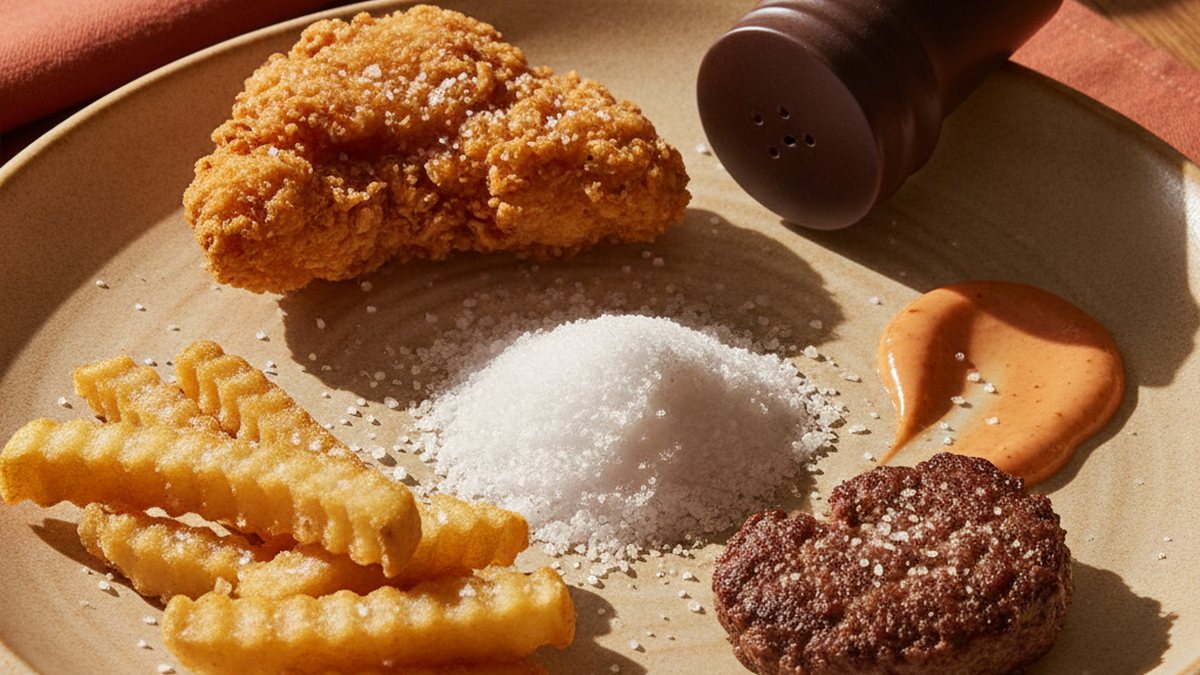
Calories get the headlines and the legislation. Sodium is arguably the more consequential number in chain food, it is much harder to see, and there is very little a customer can do about most of it.
Why chain food is salty by design
Salt is doing at least four jobs at once, which is why it is so difficult to reduce without changing a product.
- Flavour. The obvious one. Salt makes food taste of more than itself.
- Preservation and shelf life. Critical in a supply chain built on frozen and chilled distribution to thousands of outlets.
- Texture and moisture. Salt changes how proteins hold water, which affects how a patty behaves under a hot lamp.
- Consistency. Standardised seasoning is how a product tastes the same in two thousand kitchens run by people trained for a week.
That last one is underrated. Consistency is the entire promise of a chain, and heavy standardised seasoning is one of the cheapest ways to deliver it.
Where the sodium actually is
Not mostly where people look. The fries carry a visible sprinkle and get the blame; the larger contributions are usually elsewhere in the order.
| Source | Why it adds up | Can you control it? |
|---|---|---|
| Sauces and dressings | Salt-heavy and applied generously | Yes - Ask for less or on the side |
| Cured and processed meats | Bacon and cured toppings are salt-preserved | Yes - Omit |
| Cheese | Processed cheese is high in sodium | Yes - Omit |
| Bread and buns | Small per-gram amount, large per-portion | Rarely |
| Seasoned coatings on fried items | Seasoning is in the coating, not on top | No |
| Visible salt on fries | Real but usually the smallest of these | Yes - Ask for unsalted |
Note how many rows are outside the customer's control. The seasoning in a coating is applied at a factory, and no counter request reaches it.
Reformulation has actually worked
The genuinely encouraging part of this story is on the supply side. Voluntary salt reduction programmes - The UK's is the most studied - Set category-by-category targets and asked manufacturers and restaurant groups to hit them over years, allowing gradual reduction that consumers did not notice.
Palates adapt. A 20% reduction spread over five years is invisible; the same cut overnight is a customer complaint.
The mechanism matters: gradual, category-wide and voluntary-but-monitored, so no single brand loses out by moving first. Progress has been uneven and the out-of-home sector has generally lagged packaged food, but the direction has been real.
The visibility problem
Sodium is much less visible than calories. Where calorie labelling is mandatory it appears on the board; sodium generally does not, and it is often missing from published nutrition data too.
Our own database reflects the wider pattern. We hold allergen data on 2,165 items and calorie data on 29 - And no published sodium figures at all, because the menus we collect do not carry them. We do not estimate nutrition values, so where a source is silent, so are we. That is set out on the methodology page.
Where to find sodium figures
Brand nutrition pages and apps, where they exist, are the only reliable source. In several of the markets we track there is no requirement to publish them at all, and many brands do not.
What a customer can actually control
Four levers, in rough order of effect:
- Sauce. On the side or omitted. The single biggest controllable contribution in most orders.
- Cured meat and cheese. Bacon and processed cheese are both salt-dense; leaving one off is a meaningful reduction.
- Portion. Sodium scales with quantity as reliably as energy does.
- Unsalted fries. Available on request at many chains, usually with a short wait for a fresh batch.
What you cannot control is the seasoning inside a coating or a marinade, which is typically the largest single contribution in fried chicken products. That is a formulation decision, and the only route to changing it is the reformulation programmes described above.
For the broader ordering strategy this sits inside, see ordering better at a chain restaurant.