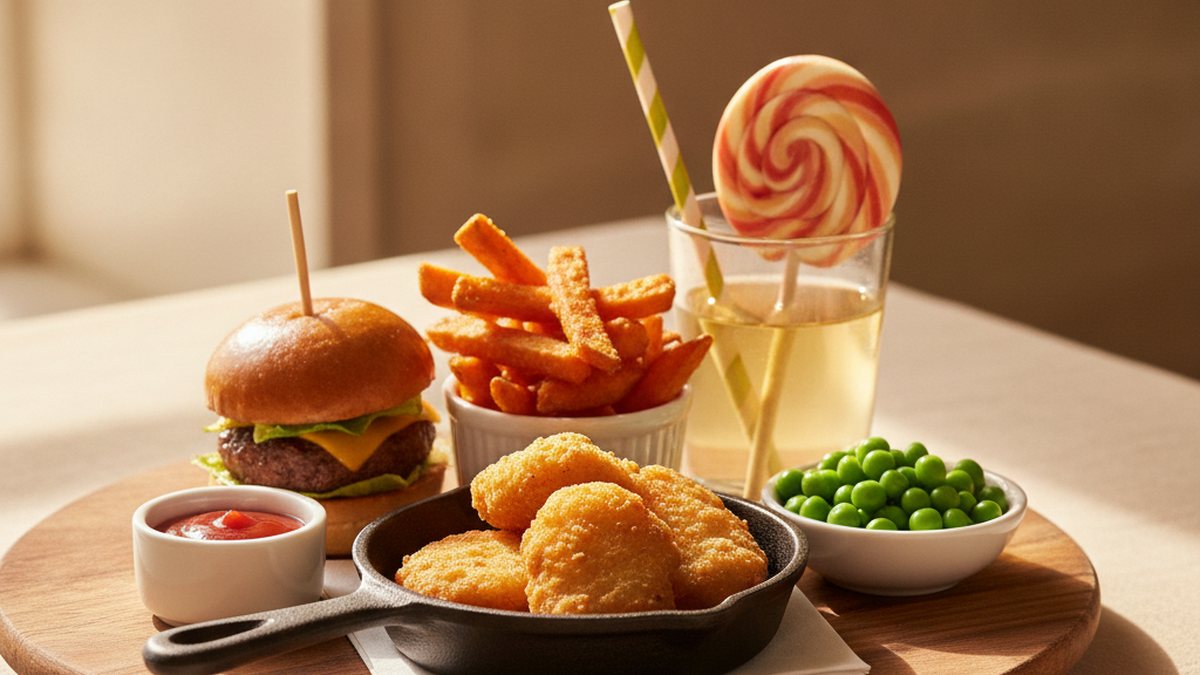
The children's menu is the most strategically important small section of any restaurant board. It sells very little food and decides a great deal of business, because in a family the person with the least money frequently makes the choice of venue.
Why kids' menus exist
The commercial logic is simple and well understood. A child with a strong preference for one restaurant will express it loudly and repeatedly. If the visit happens, the adults buy full-price meals. The kids' meal itself barely needs to make money - It needs to make the visit happen.
Everything else about the format follows from that. The fixed price removes negotiation. The small portion controls cost. The non-food element - A toy, a book, a puzzle on the box - Creates a reason to prefer one brand over another that has nothing to do with the food.
The format barely changes anywhere
This is the striking thing when you look across markets. Chain menus localise heavily - rice in Manila, noodle sets in Hong Kong, peri-peri in London - But the children's menu is close to identical everywhere: a small main, a side, a small drink, and something to keep a child occupied.
| Component | Typical option | What changed in the last decade |
|---|---|---|
| Main | Small burger, nuggets, or a small local equivalent | Least changed element |
| Side | Fries by default | Fruit, vegetable sticks or yoghurt added as alternatives |
| Drink | Fizzy drink by default | Water, milk or juice now the advertised default in many markets |
| Extra | Toy or activity | Increasing move to books and non-plastic items |
The two rows in the middle are where the real change happened. Advertising rules, voluntary industry commitments and public-health pressure pushed several markets to change the default side and drink rather than the options available. That distinction matters: defaults are what most people accept.
Why our count is so low
We classify only 58 items across all 255 menus as kids' meals, which understates reality. Most children's options are sold as a bundle with a single line on the board rather than as individually listed items, so they are counted once rather than as their components. It is a good example of a menu structure defeating a classification.
Where regulation reshaped the menu
Children's food marketing is one of the more heavily regulated corners of the industry, and the rules differ sharply by market. Restrictions on advertising to children, on promotional toys tied to specific nutritional profiles, and on default sides and drinks all exist somewhere.
The response from chains has generally been to change defaults rather than remove options - Offering fruit or a vegetable side as the standard while keeping fries available on request. It is a genuine improvement in aggregate, because most customers take the default, and it is also the least disruptive possible response.
Change the default and you change most orders. Change the options and you change almost nothing.
The nutrition question
Kids' meals are the part of a menu where nutrition information matters most and is published least consistently. Across our whole database only 29 items carry a published calorie count, and allergen information - Present on 2,165 items - Is far more commonly available than energy data.
That is a real gap, and it is worth knowing about before assuming a menu board will answer a nutrition question. We cover what is and is not published, market by market, in calorie labelling rules and allergen information on menus.
Ordering practically
- Ask for the non-default side and drink if you want them - They are usually available and usually not advertised.
- Check whether two kids' meals beat one adult meal for two smaller appetites. Frequently they do.
- Allergen information is the one thing to ask for directly. It is better documented than energy data and staff are generally trained on it.
For what a specific market's children's range looks like, the kids' meals directory can be filtered by country and brand, and every item links back to the full menu it came from.