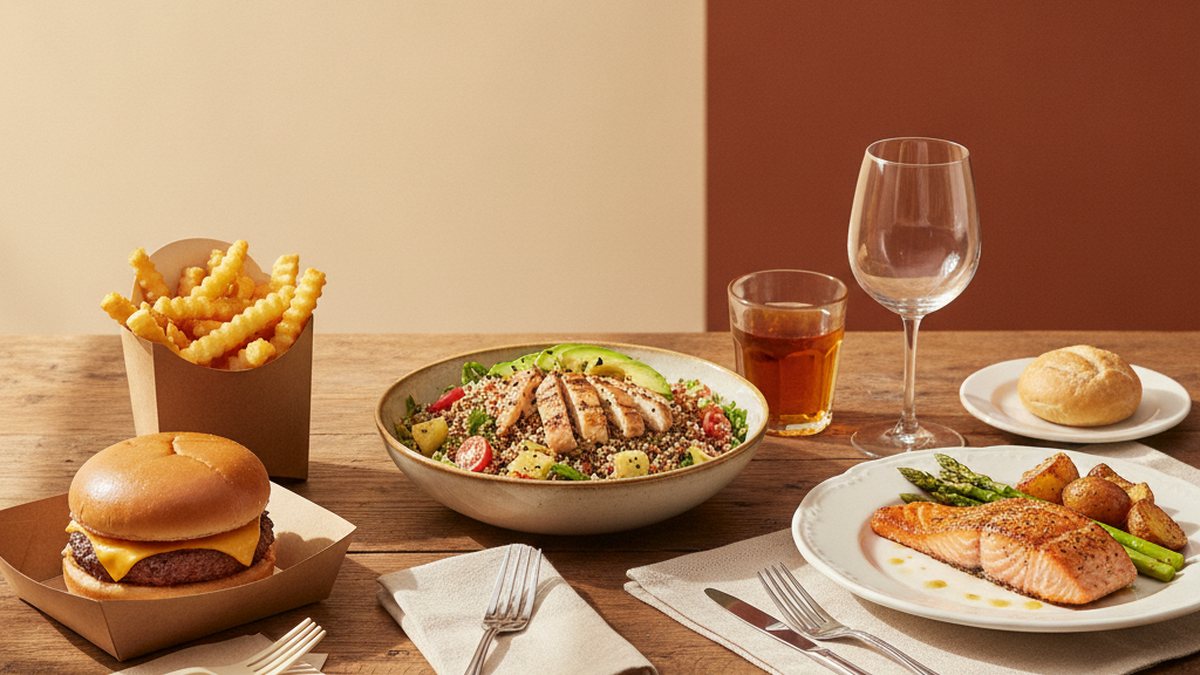
The industry categories sound like judgements about quality. They are not. They are descriptions of an operating model - How many people you serve per hour, how much labour each order takes, and whether anyone sits down.
The three models
| Fast food | Fast casual | Casual dining | |
|---|---|---|---|
| Order at | Counter, kiosk or drive-thru | Counter, assembled to order | Table |
| Food prepared | Batch, held ready | To order, from prepped components | To order, in a full kitchen |
| Typical dwell time | Minutes | Longer, often seated | An hour or more |
| Menu size | Small | Small but highly customisable | Large |
| Labour per order | Lowest | Higher | Highest |
| Price point | Lowest | Middle | Highest |
Everything else follows from the labour row. More labour per order means fewer orders per hour from the same building, which means a higher price per order to cover the same rent.
Menu size gives the category away
Our data shows this very clearly. A kitchen holding items ready in batches needs a small menu, because every additional item is another batch to hold and waste. A kitchen cooking to order can carry a much larger range, because nothing is held.
The casual-dining brands in our directory - Sizzler, TGI Friday's, Outback Steakhouse, Chili's - Consistently carry the largest boards. The quick-service brands carry the smallest. It is one of the most reliable signals in the whole dataset.
What fast casual actually is
The middle category is the least well defined and the most commercially interesting. Its distinguishing feature is assembly to order at a counter: components are prepped in advance, but the specific item is built while you watch.
That model buys two things. Customisation, which is genuinely valuable and hard for batch kitchens to match. And a perception of freshness, because you saw it made - Which supports a higher price than a batch-held equivalent.
Fast casual sells you the assembly, not just the food.
In our directory, Subway, Five Guys, Shake Shack and Pret A Manger sit in or near this category, and their price positions reflect it. A Five Guys cheeseburger averages $11.25 across ten markets - Well above a quick-service equivalent and well below a casual-dining steak.
Why cross-category comparisons mislead
A common complaint is that a particular burger "costs more than a restaurant meal". Sometimes true, and it is comparing two different businesses: one selling speed and one selling an hour of a table with someone bringing things to it.
Our price index compares like with like - The same product, the same brand, across markets - Precisely to avoid this. Comparing a fast-casual burger to a quick-service one tells you about category, not about value.
The lines are blurring, deliberately
Quick-service brands have added table service, better interiors and premium tiers. Casual-dining brands have added counter collection, delivery and simplified menus. Both are moving toward the middle, because the middle is where the margin per square metre is best.
The result is that the categories describe a spectrum rather than three boxes. What still separates them reliably is the operating model underneath - How much labour per order, how long the customer stays - And menu size remains the easiest visible proxy. See table service at a fast-food counter for one side of that convergence.