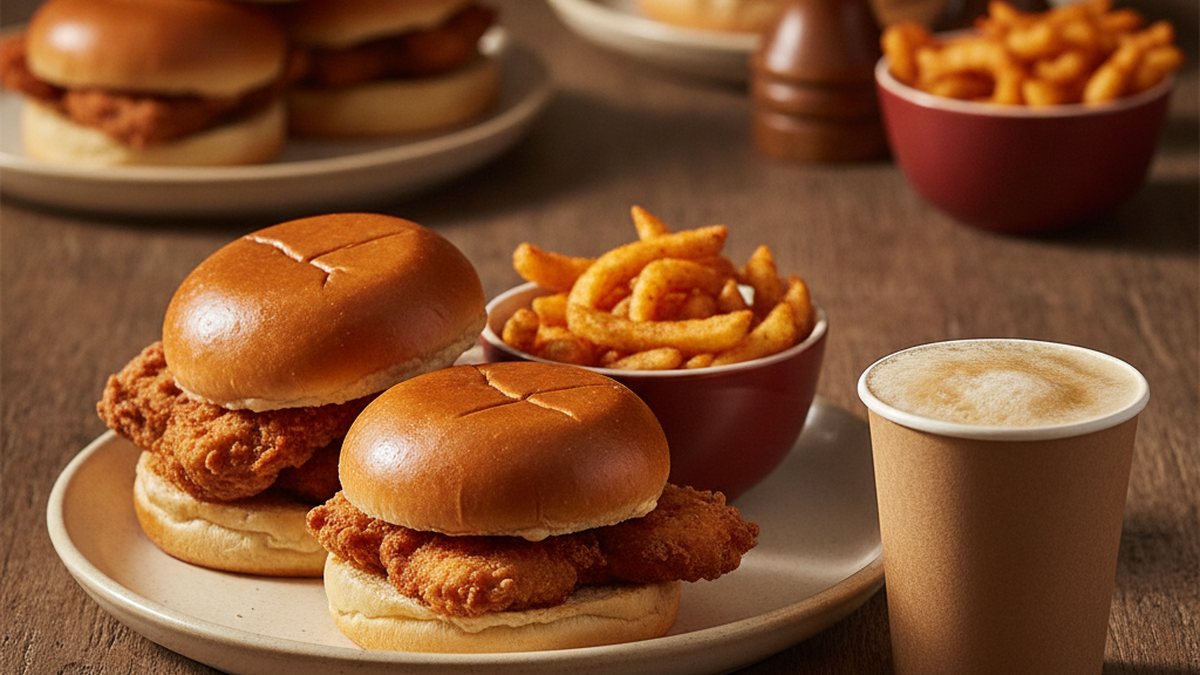
Every chain in our database runs some version of a value range, and almost none of them make meaningful money on it. That sounds like a contradiction until you understand what the cheap end of a menu board is actually for.
The job of a value menu
Three jobs, in order of importance. First, traffic: a low advertised price is the cheapest way to get someone to choose your car park over the one next door. Second, anchoring: a £1.09 burger on the board makes a £5.49 burger feel like a considered upgrade rather than an expensive sandwich. Third, defence: it stops a cheaper competitor from owning the price-sensitive customer entirely.
Profit is not on that list, and it does not need to be. The value item is the hook; the money is in what gets added to it - The drink, the upsize, the side. A customer who walks in for a value burger and leaves with a combo has done exactly what the range was designed to make them do.
How value ranges are engineered
Look closely at any value menu and you will notice it is not a set of cheap products. It is a small set of components recombined: a small patty, a bun, a slice of cheese, a sauce, a wrap, some chicken. Four or five inputs generate eight or ten menu lines.
That is deliberate. Every additional ingredient in a kitchen costs storage, prep, training and waste. A value range that introduces no new components adds menu variety at close to zero operational cost. It is one of the most elegant pieces of design in the industry and it is completely invisible from the customer side.
The tell
If two items on a value range differ only by one ingredient - Cheese, bacon, a sauce, a second patty - You are looking at component recombination rather than two distinct products. The price gap between them is close to pure margin.
The decoy at the bottom
The single cheapest item on a board is often not intended to be bought in volume. It exists to be seen. Our data is full of these: a C$0.25 side in Canada, a £0.30 side in the United Kingdom, a RM0.10 drink in Malaysia. No business runs on those numbers. They anchor the perception of the whole board.
The cheapest thing on the menu is usually an argument, not an offer.
The practical consequence: never judge a market or a brand by its floor price. Judge it by the average across the board, which every menu page on this site publishes, or by its position in the price index.
Why value ranges keep shrinking
A value item is a fixed price fighting a rising cost base, so its margin compresses before anything else on the board. When input costs move sharply, the value range is the first place a chain feels it and the last place it wants to raise a headline number.
The usual sequence is: thin the range, then quietly re-tier it (the £1 item becomes a £1.29 item in a renamed range), then move the genuine discounts into the app where they are targeted and unpublished. That last step is the significant one, and we cover it in why fast food has outrun inflation.
Value looks different in different markets
The Western value-menu model - A list of individually cheap items - Is not universal. Across the Asian markets in our data, value is expressed through sets and bundles instead. Combos and meal deals are the largest category on our menus at 1,459 items, and in the Philippines and Malaysia the set is the default unit of purchase rather than an upsell.
| Market style | How value is expressed | What to compare |
|---|---|---|
| North America, UK, Ireland | A named range of individually cheap items | Item price against the standard menu equivalent |
| South-East Asia | Sets and bundles at a fixed price | Set price against the sum of its parts |
| Australia, New Zealand | A hybrid: small value range plus heavy app deals | Board price against the current app offer |
| Hong Kong, Singapore | Time-limited sets, especially at lunch | Lunch set against the same items at dinner |
Using a value range well
Two rules cover most of it. Buy from the value range and stop - The range is good value precisely up to the point where you add the things it was designed to sell you. And check the value item against the standard item it shadows: if the gap is small, the standard item is usually the better food for the money.
To see any chain's full ladder from value to premium in one view, open its menu page: Burger King in the United Kingdom and Jollibee in the Philippines are two very different approaches to the same problem.