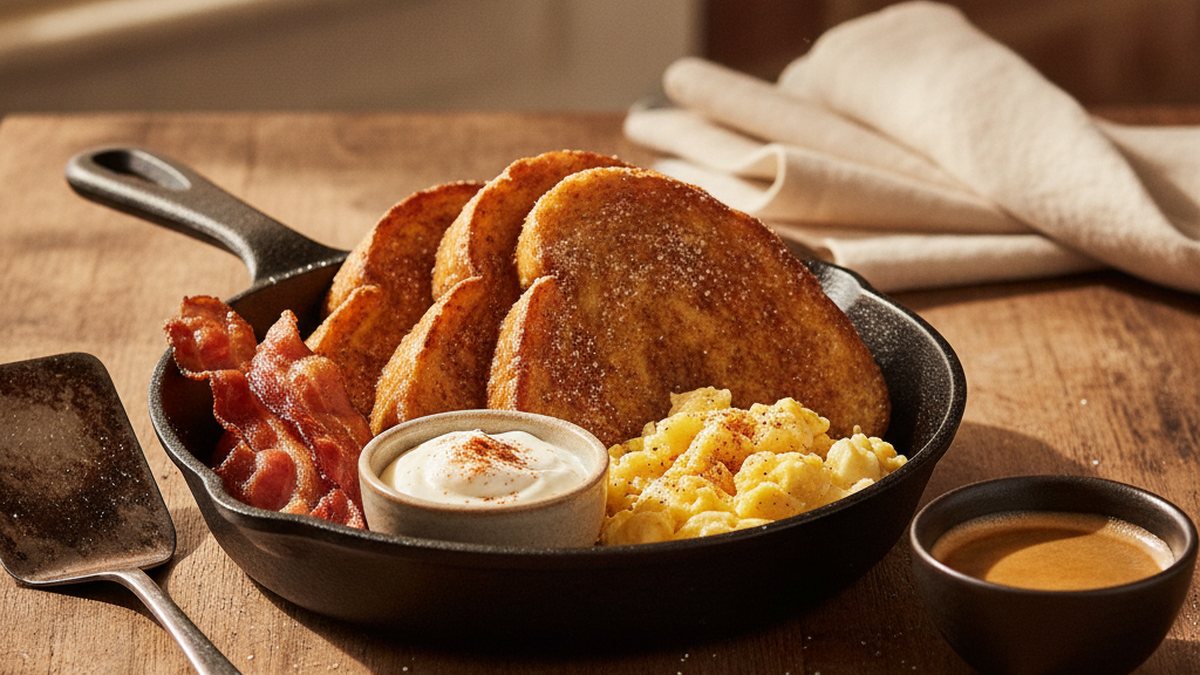
The most common complaint in fast food has a boring and completely satisfying explanation. Breakfast stops at 10:30 not because someone decided it should, but because a griddle that is cooking eggs cannot simultaneously be cooking burger patties at a different temperature.
The equipment problem
A quick-service kitchen is designed around throughput, and throughput comes from doing one thing extremely fast rather than many things adequately. Breakfast and lunch use different proteins, different holding temperatures and, critically, often the same physical surfaces.
The changeover is not instantaneous. Surfaces have to be cleared, cleaned and brought to a different temperature; holding cabinets have to be emptied and restocked. During that window the kitchen can serve almost nothing, which is why cut-offs are usually a hard time rather than a gradual wind-down.
Why all-day breakfast is harder than it looks
Running both services simultaneously requires either separate equipment or spare capacity on shared equipment. Both cost floor space, which is the scarcest resource in a quick-service restaurant. That is why all-day breakfast tends to appear in markets with larger average store footprints and disappear again when peak-hour throughput suffers.
What counts as breakfast varies enormously
Breakfast is the single most locally adapted service in chain food, because it is the meal most tied to habit. Our database holds 464 breakfast items across the markets we track, and the composition of that set changes completely from country to country.
| Market group | Typical breakfast shape | Where to look |
|---|---|---|
| North America | Egg-and-muffin sandwiches, hash browns, pancakes, filter coffee | McDonald's USA |
| United Kingdom and Ireland | Bacon and sausage rolls, breakfast wraps, strong tea | McDonald's UK |
| South-East Asia | Rice-based sets, congee, local proteins, sweet coffee | McDonald's Philippines |
| Hong Kong | Noodle sets, macaroni soup, milk tea | Hong Kong market |
| Australia and New Zealand | Café-style coffee, toasted items, wraps | McDonald's Australia |
Coffee is the constant. Breakfast is the service where a burger chain competes directly with dedicated coffee chains, and it is usually where its coffee pricing is at its most aggressive.
Why chains fight so hard for breakfast
Breakfast is a high-frequency, high-loyalty daypart. People eat lunch wherever is convenient; they buy breakfast on a route they take every day, which makes them far more habitual and far more valuable over a year. It also uses capacity that would otherwise sit idle, since the building, the staff and the rent all exist regardless.
Lunch is a decision. Breakfast is a habit, and habits are worth more.
Practical rules for not missing it
- Cut-offs vary by outlet. A national time is a guide. Airport, station and 24-hour sites frequently differ, and franchised outlets set their own.
- Weekends usually run later. Many markets extend breakfast on Saturday and Sunday by an hour or more.
- The changeover is abrupt. Arriving two minutes before a cut-off does not reliably work, because the kitchen begins switching before the clock does.
- Check the app rather than a website. App menus reflect what the outlet is currently serving; corporate pages usually show national policy.
What our data can and cannot tell you
We publish the breakfast items each market's menu carries and what they cost. We do not publish serving hours, because they vary by individual outlet and change without notice - publishing a national time would be publishing something we cannot stand behind.
What the item data does show clearly is which markets take breakfast seriously. Browse breakfast across all markets and filter by country: the depth of the range is a good proxy for how central the daypart is to that market's business. For the cultural side of the same story, see breakfast around the world.