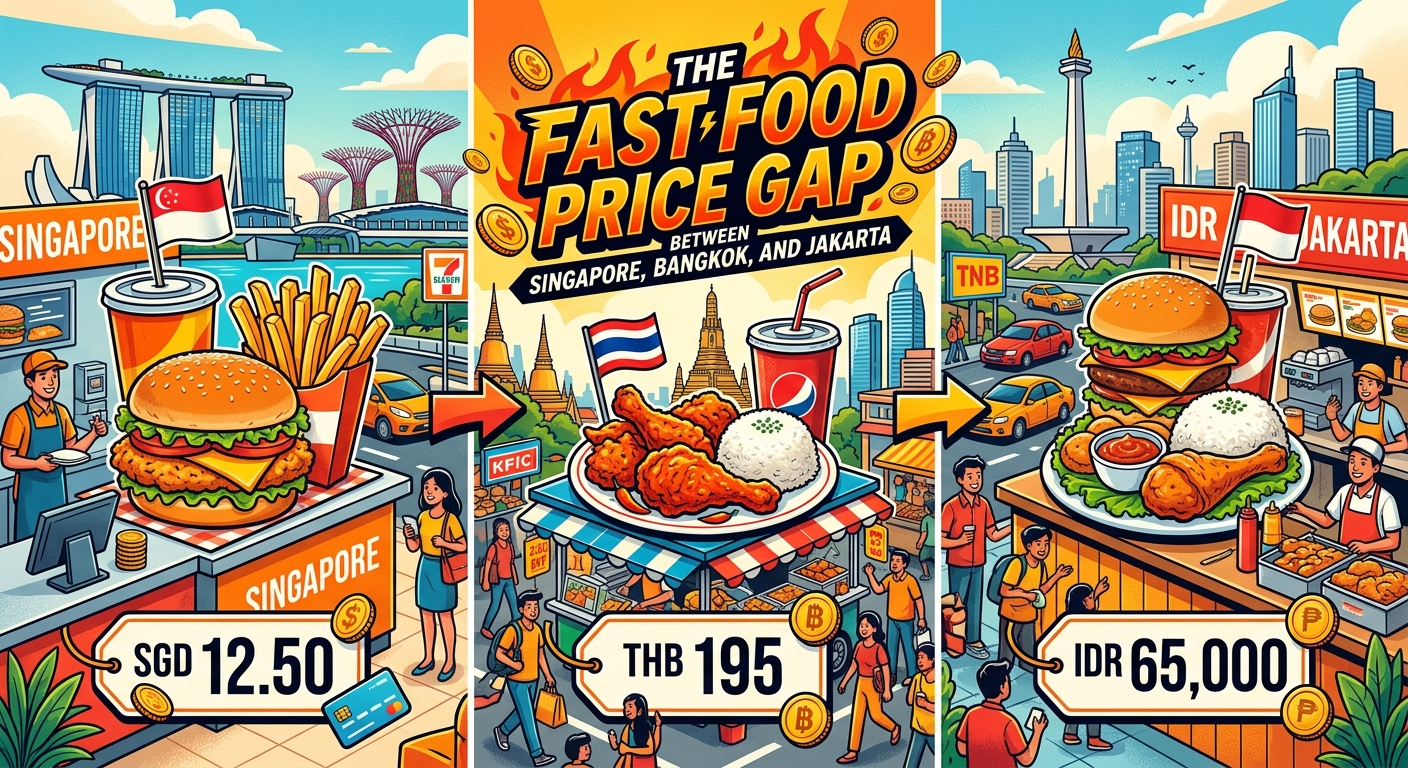
Three cities. One bucket of fried chicken. Three very different price tags. A KFC set meal that costs S$11.20 in Singapore will run about THB 230 in Bangkok and roughly IDR 70,000 in Jakarta. Convert those to US dollars and you are looking at a spread of nearly four dollars on an almost identical product. That is not a small rounding error. That is a deliberate result of franchise economics, city-level cost structures, and trade policy playing out every time someone orders a two-piece meal with rice.
Southeast Asia holds some of the world's densest concentrations of global fast-food chains. McDonald's, KFC, and Jollibee all have deep roots across the region, but their prices do not behave like a single regional market. Singapore reads like a European capital. Bangkok sits in a comfortable middle zone. Jakarta offers the lowest tag, but that number requires context to interpret honestly.
Price Reality Check: The gap between these three cities is wider than most travelers expect, and the reasons run far deeper than currency.
- A standard McDonald's or KFC set meal costs roughly 65 to 80 percent more in Singapore than in Jakarta, measured in USD equivalent.
- Rental costs, import duties on chicken and potatoes, and franchise royalty structures each add separate, stacking pressure to menu prices in different cities.
- Bangkok benefits from domestic poultry supply chains and lower commercial rents than Singapore, though not as low as Indonesian markets outside the capital core.
What You Actually Pay for a Meal in Each City
Tracking prices across currencies needs a common unit. USD equivalents below use mid-2025 exchange rates: roughly S$1.35, THB 36, and IDR 16,000 to one US dollar. These figures are based on dine-in prices at mall-based outlets in each city's main commercial districts. Delivery app prices carry a separate markup and are not included here.
McDonald's spicy chicken meals carry different local names across Southeast Asia, but the format is consistent enough to benchmark. In Singapore, a McSpicy Meal with fries and a drink lands around S$10.90, approximately USD 8.10. In Bangkok, the comparable meal runs THB 270, or about USD 7.50. In Jakarta, the equivalent sits between IDR 65,000 and IDR 75,000 depending on the outlet, translating to USD 4.10 to USD 4.70. That is a 70 percent gap between the cheapest and most expensive city on a near-identical product.
KFC follows a similar pattern. The Original Recipe 2-piece meal with rice, which is the dominant format across Southeast Asia, costs S$11.20 in Singapore, around THB 230 in Bangkok, and IDR 70,000 in Jakarta. Jollibee, the Filipino chain with strong footprints in Singapore and Indonesia, prices its Chickenjoy 1-piece rice meal at S$9.80 in Singapore and roughly IDR 60,000 in Jakarta. Bangkok has only a handful of Jollibee outlets, mostly near tourist corridors, and pricing there tracks closely with local KFC competitors rather than a clear brand premium.
Set Meal Price Comparison Across Singapore, Bangkok, and Jakarta (USD Equivalent, Mid-2025)
| Chain and Meal Format | Singapore (USD) | Bangkok (USD) | Jakarta (USD) |
|---|---|---|---|
| McDonald's Spicy Chicken Meal | ~8.10 | ~7.50 | ~4.40 |
| KFC 2-Piece Meal with Rice | ~8.30 | ~6.40 | ~4.40 |
| Jollibee Chickenjoy 1-Piece Rice Meal | ~7.30 | ~6.00* | ~3.75 |
*Bangkok Jollibee pricing is based on a limited sample from tourist-area outlets. Brand coverage in the city remains thin.
Singapore's Premium Price Tag Has Layers
Singapore charges more because almost every input costs more. The city-state imports roughly 90 percent of its food. That means chicken, potatoes for fries, cooking oil, and packaging all carry import logistics costs that simply do not exist at the same scale in Indonesia or Thailand, both of which have domestic agricultural industries supplying a meaningful share of fast-food inputs.
Commercial rental in Singapore is among the highest in Asia. A fast-food outlet in an Orchard Road or VivoCity mall pays per-square-foot rates that would be unrecognizable to a franchise operator in central Bangkok, let alone in a Jakarta suburb. That rent does not get absorbed quietly by the brand. It gets built into the menu, item by item.
Singapore's Progressive Wage Model mandates higher floor rates for food service workers than what a Jakarta KFC outlet pays counter staff. Labour is expensive, and that cost flows directly into the price of every item sold. Cross-country food price benchmarking has long flagged Singapore as an outlier in Southeast Asia, not just against Indonesia and Thailand but against many developed markets too. No single factor explains it. It is the accumulation of all of them.
Bangkok Walks a Middle Path
Bangkok's prices occupy an interesting position. They are meaningfully lower than Singapore on most items but not as low as Jakarta. That spread has several explanations, and they point to how deeply a city's food supply chain shapes what you pay at the counter.
Thailand has a well-developed domestic poultry industry. CP Group, one of the largest agribusiness conglomerates in Asia, supplies a significant portion of the chicken used by fast-food chains operating in Thailand. Local supply chains reduce import exposure, and that cost advantage passes, at least partially, into the menu. A KFC bucket in Bangkok is cheaper partly because the chicken did not travel far and was not subject to import duties.
Bangkok's commercial rents are high by Southeast Asian standards, especially in malls along the BTS Skytrain corridor and in central business districts. But the absolute figures still trail Singapore by a wide margin. A fast-food unit in a mid-tier Bangkok mall pays rent that is a real cost but not a structurally distorting one. That leaves room for the chain to price more competitively while maintaining margin.
Thailand also operates a national minimum wage framework. As of recent adjustments, the daily minimum in Bangkok sits around 363 baht. That translates to a monthly figure that falls between Singapore's effective floor and Jakarta's. Labour costs are a genuine factor in Bangkok, though not at the same level as in Singapore, where wages for food service workers have been rising steadily under Progressive Wage policy.
Jakarta Prices Seem Low Until You Run the Numbers
The IDR figures look tiny to any visitor from Singapore. But context matters enormously. Indonesia's regional minimum wage system calibrates wage floors to local cost of living. A fast-food worker in Jakarta earns a wage that reflects Jakarta's market, which is higher than in smaller Indonesian cities but still well below Bangkok or Singapore in absolute terms. Those wages flow into menu prices.
Indonesia charges import duties on certain food categories and has specific requirements around halal certification that affect how ingredients are sourced and verified. For fast-food chains, maintaining halal compliance across the supply chain requires certified suppliers and regular third-party audits. McDonald's Indonesia, KFC Indonesia, and Jollibee Indonesia all operate under the MUI halal certification framework, and that certification at scale carries administrative and supply chain costs that are not trivial.
Despite those structural costs, the combination of lower wages, lower rents outside the CBD core, and a large domestic food supply keeps Jakarta prices the lowest of the three cities. The math works at those price points because the cost base allows it. A franchisee in Jakarta cannot price at Singapore levels even if they wanted to. The consumer base and competitive landscape would not bear it.
How Franchise Fee Structures Shape the Menu
Every McDonald's, KFC, and Jollibee outlet in Southeast Asia pays a royalty to the global brand. These fees are typically structured as a percentage of gross revenue, often in the 4 to 6 percent range, though the exact figure depends on the franchise agreement and the market. For a high-volume Singapore outlet turning over S$3 million a year, that is a large absolute number. For a Jakarta outlet doing a fraction of that volume, the same percentage rate produces a much smaller absolute burden.
Franchise agreements require operators to maintain brand standards, use approved suppliers, and fund a portion of national advertising spend. In markets where a single company holds a master franchise for an entire country, these costs get spread across the full portfolio. How efficiently that master franchisee manages the network determines how much of the fee structure ends up in the menu price versus absorbed in operational margin.
Singapore's master franchise operators work in a very high-cost environment. That feeds into the baseline pricing strategy across every outlet, not just the premium locations. In Indonesia, larger franchisee networks benefit from scale but face a consumer base with lower average willingness to pay. Both constraints are real, and they push pricing in opposite directions from a global brand average.
Checking Which Chains Are Actually Available in Each City
Price comparisons only matter if the chain you are planning around is actually present in your destination. Coverage varies more than most people expect. Jollibee has a strong Singapore and Indonesian presence but a very thin Bangkok footprint. Some regional chicken chains popular across Java have no Singapore presence at all. Some breakfast chains dominant in Kuala Lumpur barely operate in Jakarta.
Before building a meal plan or a budget estimate around a specific chain, it is worth verifying availability. Using a fast food finder to check which chains operate in a given market can prevent the disappointment of arriving at a Bangkok mall expecting a Jollibee that simply is not there. Knowing what is available also shapes how you read price data. If your preferred chain does not operate in one city, any price comparison you are making is across different products rather than the same one.
What Three Price Tags Tell You About Three Very Different Economies
The price gap between Singapore, Bangkok, and Jakarta is not a flaw in how these chains operate. It is the system functioning as designed. Each city prices to its own cost reality. That reality reflects geography, trade policy, domestic agriculture, wage regulation, and the commercial real estate market. No single variable explains the spread. All of them together do.
For travelers, the practical lesson is that fast food is not a budget equalizer across Southeast Asia. A meal that registers as cheap in Jakarta is a mid-range spend in Singapore. Budgeting by chain name rather than by city will produce consistent surprises. Budget by city first, then by chain.
For franchise operators and F&B entrepreneurs thinking about market entry, the data surfaces something important. Regional wage floor data across these three markets shows differences large enough to reshape the unit economics of a franchise entirely. A model that thrives in Jakarta on local pricing may struggle to sustain itself in Singapore without either a premium price strategy or a fundamentally leaner cost structure. The same brand, the same menu, the same training standards, but a completely different financial equation in each city.
That is what makes these three markets so instructive to compare. They sit within two hours of each other by air. They share many of the same brand names and the same menu formats. But beneath the surface, they are operating in three distinct economic environments, each with its own floor on what things can cost and its own ceiling on what customers will pay. The gap in those price tags is not random. It is a compressed map of everything that makes each city what it is.